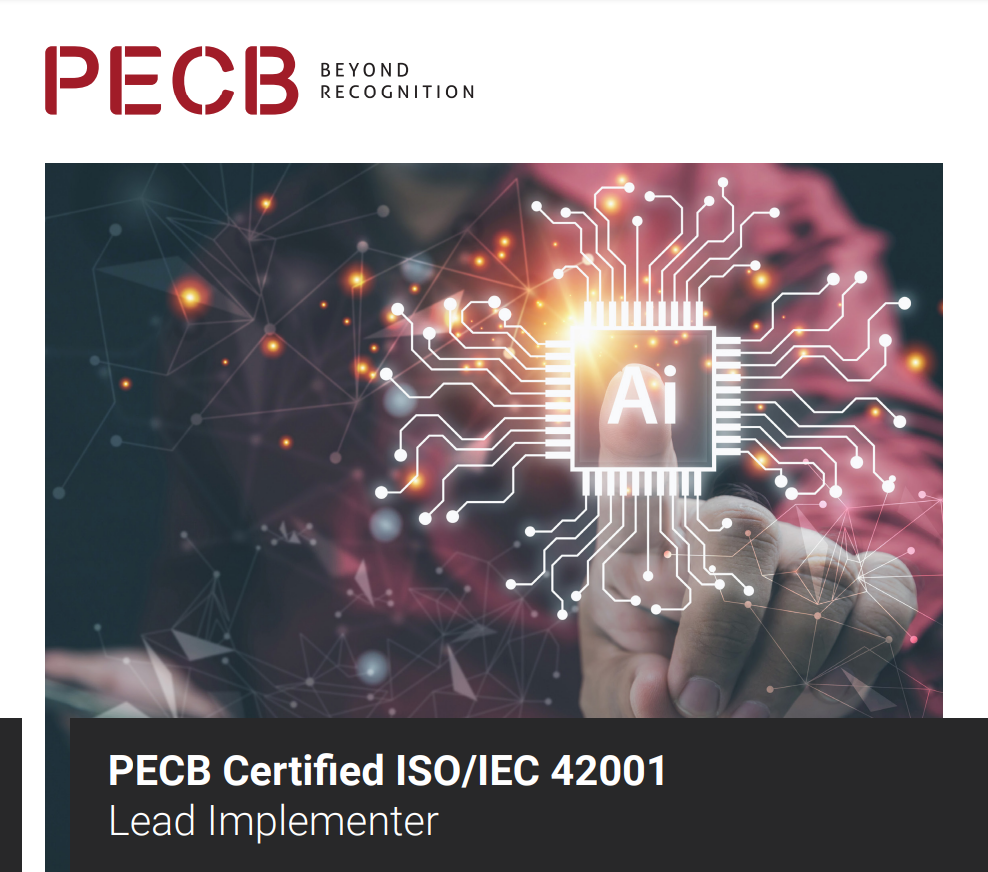
ISO/IEC 42001 Lead Implementer (Instructor-Led Online) - Artificial Intelligence Management System
Is this a Certification Course? Yes, this is a certification course. Certification and examination fees are included in the price of the training course.
Delivery Model: Instructor-Led Online
Exam Duration: 3 hours
Retake Exam: You can retake the exam once within one year
Price: US$ 1950 / CAD$ 2600
What is ISO/IEC 42001?
As the world witnesses the relentless advancement of Artificial Intelligence (AI), there is an increasing need for effective standardization and regulation to ensure its responsible use.
ISO/IEC 42001 has been developed to respond to urgent inquiries concerning AI's unchecked expansion and potential threats. It specifies the requirements and offers guidance to establish, implement, maintain, and continually improve an AI management system (AIMS) within the context of an organization. It provides a framework for the ethical implementation of AI systems, offering a comprehensive approach to ensure that AI technologies align with the principles of fairness, transparency, accountability, and privacy.
Why is Artificial Intelligence Important for You?
In an ever-evolving world characterized by the relentless progress of technology, the influence and importance of artificial intelligence have reached new heights. AI is set apart by its remarkable ability to transcend industry boundaries. It is not limited to a particular sector; instead, it possesses the capacity to trigger transformation across a wide range of industries.
PECB ISO/IEC 42001 training courses equip individuals with the competencies needed to plan, develop, implement, maintain, and improve an AI management system within organizations. An effective AIMS enables organizations to utilize the full potential of AI in an era where technological adaptation is synonymous with progress and success. Additionally, it helps organizations maintain a competitive edge in the constantly changing tech and business environment.
Benefits of PECB ISO/IEC 42001 Certification
A PECB ISO/IEC 42001 certificate demonstrates that you can:
- Comprehend the regulatory and ethical considerations surrounding AI implementation.
- Assist an organization in aligning the AI initiatives with its core business objectives.
- Support an organization in developing and implementing an AI management system.
- Evaluate the quality, reliability, and performance of AI systems.
- Ensure that AI solutions meet high standards and function as intended.
- Identify potential AI-related risks and implement necessary measures to mitigate those risks.
Course Content
Day 1: Introduction to ISO/IEC 42001 and the initiation of an AIMS implementation
Day 2: Planning the implementation of an AIMS
Day 3: Implementation of an AIMS
Day 4: AIMS monitoring, continual improvement, and preparation for the certification audit
Day 5: Certification exam
Examination
The “PECB Certified ISO/IEC 42001 Lead Implementer” exam meets all the PECB Examination and Certification Program (ECP) requirements. It covers the following competency domains:
Domain 1: Fundamental principles and concepts of an artificial intelligence management system (AIMS)
Domain 2: Artificial intelligence management system requirements
Domain 3: Planning of an AIMS implementation based on ISO/IEC 42001
Domain 4: Implementation of an AIMS based on ISO/IEC 42001
Domain 5: Monitoring and measurement of an AIMS based on ISO/IEC 42001
Domain 6: Continual improvement and preparation for an AIMS certification audit
Certification
After passing the exam, you can apply for one of the credentials listed in the table below. You will receive a certification once you fulfill all the requirements of the selected credential.
The AIMS project experience should follow best implementation practices and include the following:
- Drafting an AIMS implementation business case
- Managing an AIMS implementation project
- Implementing an AIMS
- Managing AIMS documented information
- Establishing metrics
- Implementing corrective actions
- Monitoring the AIMS performance
- Managing an AIMS implementation team
General Information
- Certification and examination fees are included in the price of the training course.
- Participants receive training course materials containing over 400 pages of information, practical examples, exercises, and quizzes.
- An attestation of course completion worth 31 CPD (Continuing Professional Development) credits will be issued to the participants who have attended the training course.
- Candidates who have completed the training course but failed the exam are eligible to retake the exam once for free within 12 months from the initial date of the exam.
Price: US$ 1950 / CAD$ 2600

Our latest blog posts